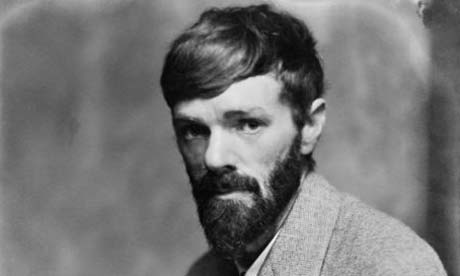
D.H Lawrence
English novelist, storywriter, critic, poet and painter, one
of the greatest figures in 20th-century English literature. "Snake"
and "How Beastly the Bourgeoisie is" are probably his most anthologized
poems.
David Herbert Lawrence was born on September 11, 1885, in
Eastwood, Nottinghamshire, central England. He was the fourth child of a
struggling coal miner who was a heavy drinker. His mother was a former
schoolteacher, greatly superior in education to her husband. Lawrence's
childhood was dominated by poverty and friction between his parents. He was
educated at Nottingham High School, to which he had won a scholarship. He
worked as a clerk in a surgical appliance factory and then for four years as a
pupil-teacher. After studies at Nottingham University, Lawrence matriculated at
22 and briefly pursued a teaching career. Lawrence's mother died in 1910; he
helped her die by giving her an overdose of sleeping medicine.
In 1909, a number of Lawrence's poems were published by Ford
Max Ford in the English Review. The appearance of his first novel, The White
Peacock(1911), launched Lawrence into a writing career. In 1912 he met Frieda
von Richthofen, the professor Ernest Weekly's wife and fell in love with her.
Frieda left her husband and three children, and they eloped to Bavaria.
Lawrence's novel Sons and Lovers appeared in 1913 and was based on his
childhood . In 1914 Lawrence married Frieda von Richthofen, and traveled with
her in several countries. Lawrence's fourth novel, The Rainbow (1915), was
about two sisters growing up in the north of England. Lawrence started to write
The Lost Girl in Italy. He dropped the novel for some years and rewrote the
story in an old Sicilian farmhouse near Taormina in 1920.
During the First World War Lawrence and his wife were unable
to obtain passports and were targets of constant harassment from the
authorities. They were accused of spying for the Germans and officially
expelled from Cornwall in 1917. The Lawrences were not permitted to emigrate
until 1919, when their years of wandering began.
Lawrence's
best known work is Lady Chatterly's Lover, first published privately in
Florence in 1928. It tells of the love affair between a wealthy, married woman,
and a man who works on her husband's estate. The book was banned for a time in
both UK and the US as pornographic. Lawrence's other novels from the 1920s
include Women In Love (1920), a sequel to The Rainbow.
Aaron's Rod
(1922) shows the influence of Nietzsche, and in Kangaroo (1923) Lawrence
expressed his own idea of a 'superman'. The Plumed Serpent (1926) was a vivid
evocation of Mexico and its ancient Aztec religion. The Man Who Died (1929), is
a bold story of Christ's Resurrection. Lawrence's non-fiction works include
Movements In European History(1921), Psychoanalysis And The Unconscious (1922)
and Studies In Classic American Literature (1923).
D.H.
Lawrence died in Vence, France on March 2, 1930. He also gained posthumous
renown for his expressionistic paintings completed in the 1920s.
The above
biography is copyrighted. Do not republish it without permission.
Review on "Odour of Chrysanthemums"
The main theme of the story is the isolation that Elizabeth experiences, first through waiting for her husband, and after through his death. There is also another element which is continually present in the story: chrysanthemums. These flowers appear a few times throughout the book. They clearly evoke a mixture of feelings to Elizabeth, as she is seen telling her son off for picking them in the garden, remembering how one day her drunk husband walked in with a brown chrysanthemums on his button-hole; but she also keeps them in the house in vases, so they clearly also hold some good memories.
The main character is Elizabeth. She is the wife of Walter Bates. She appears to be a very bitter person, who hasn´t enjoyed life much and blames herself for this, as it was her fault having married Walter. She experiences a psichological turn when they bring in the dead body of her husband, as she seems to see him for the first time as a human person. She realises that she hasn´t ever tried to understand him. She´s only felt that she had to bear with him, putting up with his bad behaviour and the humiliation of having a husband like that.
Walter Bates is a character that never appears alive in the story but has a central part in it. All we know about him is that he is a insensitive husband and parent who prefers to spend his afternoons in the pub rather than at his home, with his wife and kids.
The story has a disturbing element in it, not being comfortable to read. It is as if the reader is shown a day in the normal life of a miner´s wife. It is also a dark story, as the whole atmosphere of the tale is mournful, slow, sad and dark.

No hay comentarios:
Publicar un comentario